
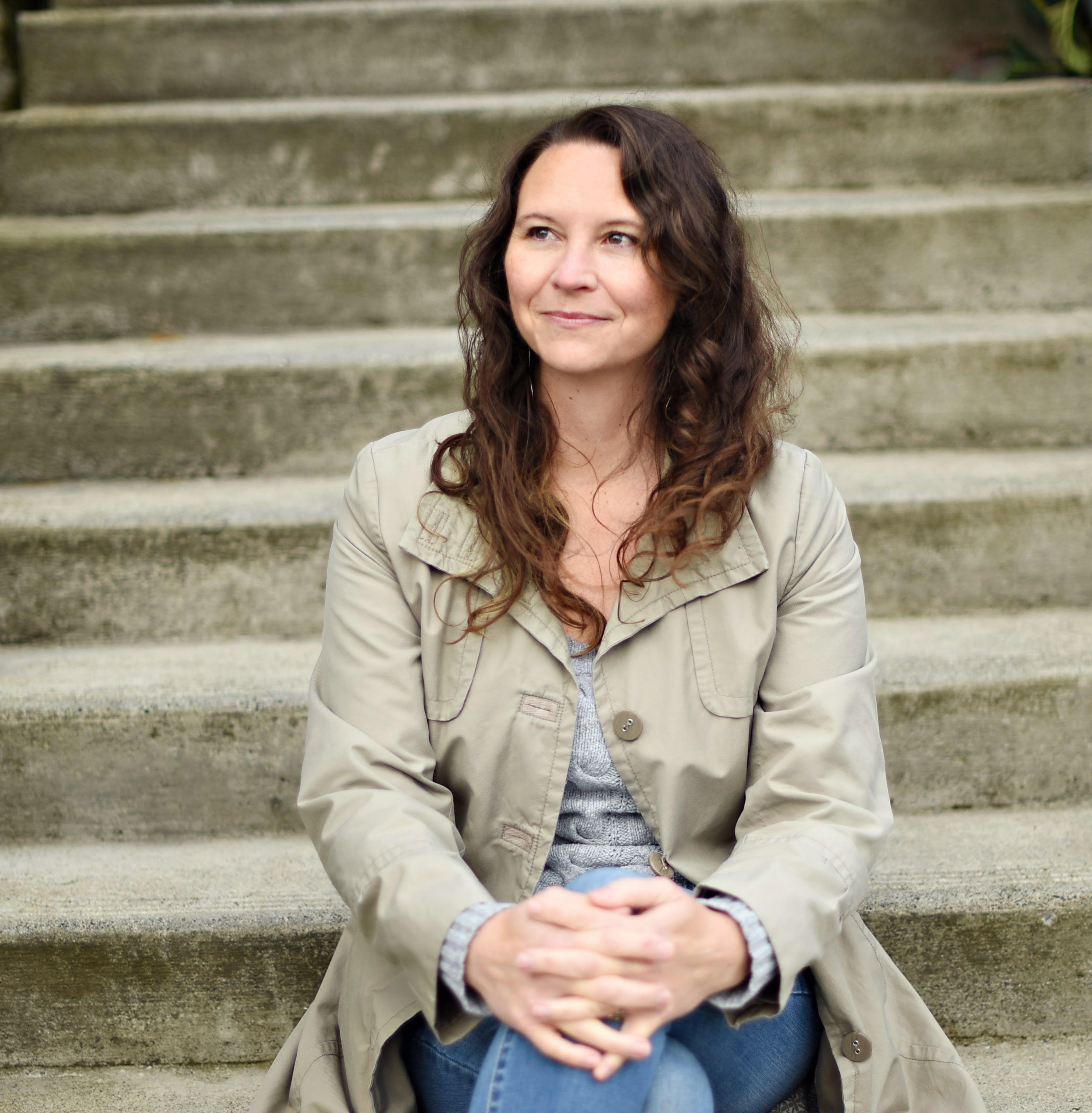
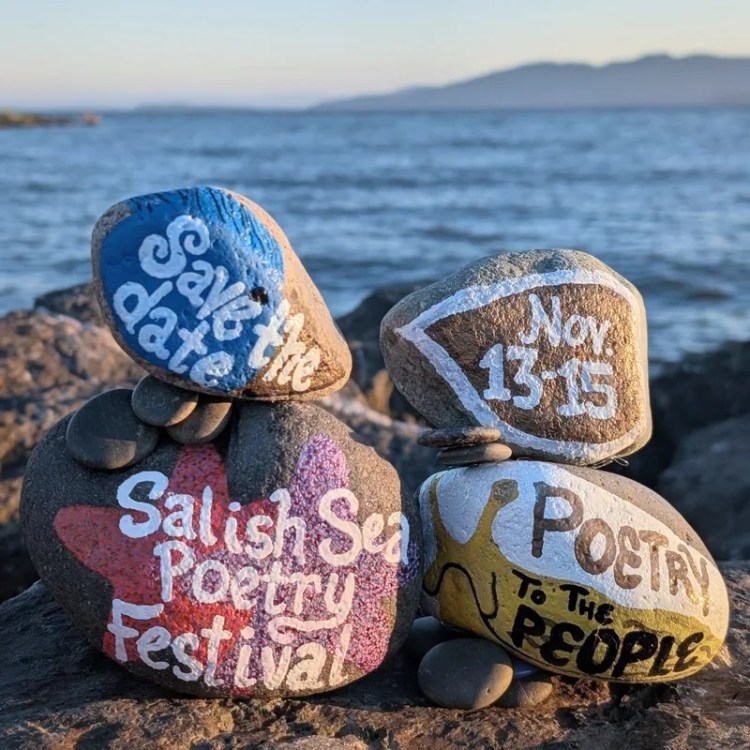
Liz Vignali, founder of the Salish Sea Poetry Festival, is the author of one poetry collection and three chapbooks, and has been producing Bellingham Kitchen Sessions for twelve years. The 2026 festival will take place from November 13-15 in Bellingham, Washington, with a variety of exciting events for poets and poetry lovers. View the full schedule here.
A scheduled reading by Palestinian poet Majd Alkurd at the Big Bad Bookstore has been postponed and will occur during Read Palestine Week, the first week of December. Keep an eye on Salish Sea Poetry Festival’s website for the exact time to come!
WISHFUL THINKING PRESS: Tell us a bit about yourself!
LIZ: Well, I moved here to Whatcom County when I was ten with my family. My dad’s side of the family were long-term Californians, but my mom’s side of the family has been here since the 1880’s. I have a deep history here, which is also–as we learn and grow–a complicated history, too. I think that made me really interested in trying to combine all of the complicated things and all of the good things about this area together.
WISHFUL THINKING PRESS: Have you been here the whole time since you moved?
LIZ: I have pretty much been here the whole time. Like most people who grow up here, or grow up anywhere, there’s this period of time that you think “I have to get away.” I didn’t go far; I lived in Seattle for a year and then was like “that’s enough big city living for me.” I mean, Bellingham is such a good thing. This is where my family is, and it’s beautiful, and there’s my community and my friends, so I moved back here … I think the real big shift for me was a combination of both having my children, which really clarifies the kind of world that you want your children to grow up in–such a cliche but it’s true–and also my mom died. She had been probably the most creative person in my life; she was always starting projects. She loved to embroider, she loved to draw, she loved to quill. She just was interested in everything and always learning and she was excited about the world in so many ways … Long story short, since my mom died I really have prioritized art in my life and bringing my children along with me.
WISHFUL THINKING PRESS: Would you say that the aspects that drive your identity are writing, being a mom, and grief?
LIZ: Definitely. I think grief clarifies things; it clarifies priorities. My driving mission I guess, if I were to try to say what it is, is being a mom, but also a community member and a daughter and a sister. We’re all surrounded by people who love different things than we love. Not everyone is a creative person. Not everyone can make the leap in imagination that an artist makes. It’s our job as artists to make that leap for them, and then bring it back to them, to say “this is what I see.”
WISHFUL THINKING PRESS: I love that. That kind of drives us into our next question. What does poetry mean to you?
LIZ: For me, poetry is a way of connecting with other people, yet so much of the poetry I love is nature based. I would consider myself an ecopoet. Most of my work is nature based and that’s what draws me, and yet I think ultimately we are trying to share the human experience with others. The poetry that really interests me, and the poems I’m interested in getting other people to read, is the poetry that expands the heart and mind beyond your lived experience. There are all of these ways that we know in our body when we read something as children that move us; it affects our whole lives. That doesn’t have to stop when we grow up. We should continue to be moved and feel things, and we’re kind of dissuaded from being moved and from feeling things right now, so I feel it’s more important than ever to share poetry. Off the top of my head, what poetry means to me, what I want people to understand about why poetry can be so powerful, there are a couple of poems that come to mind. Naomi Shihab Nye has this poem called “Gate A-4,” where she’s at an airport and her flight is delayed, and chaos ensues. It’s a beautiful poem that ends up being, again, about coming together despite language obstacles, despite cultural obstacles. It’s a beautiful poem. Ross Gay has a poem, “To the Fig Tree on 9th and Christian,” another poem that just takes you on a journey. It’s all messy and human and ends with hope. It ends with hope that most people are good people; most people love each other. When we know each other we love each other, and poems are a way of getting to know each other.
WISHFUL THINKING PRESS: You talked about this a bit with your focus on nature, but our next question is what inspires your writing?
LIZ: Definitely nature … I am so impressed by poets who can write about really big things, and I am inspired by the big things, but I write about little things most of the time. I’m very easily overstimulated and hypersensitive. The world is a very busy, bright, noisy place for many of us. Sometimes just tuning it all out and focusing on a little chickadee on a branch, and then just watching that one little bird make decisions and do what it’s doing, allows you the peace to think … Am I being driven by instinct? Am I being driven by biology? This search, the little things, open[s] up the big questions.
WISHFUL THINKING PRESS: It pulls you back and gives you a chance to have that moment of mindfulness to reexamine.
LIZ: Just sitting on the ground and looking around you in the woods is fucking important. Really fucking important. To just exist in this world and try to not be influenced by anything for a minute, two minutes, three minutes [is] really hard … A poem invites you to do that in an attainable way. It can guide you; it guides me as the writer. I think sometimes, as we’re writing the poem, we are understanding what it is that is happening within us and what we’re trying to say. I also do believe we connect in ways we don’t fully understand … Sometimes we write down a poem and look back at it like, “damn, did that just come out of me?”
WISHFUL THINKING PRESS: I mean we’re constantly being influenced by all the things we’ve absorbed in our lives, even if we don’t realize it. It’s cool to know that in the background of our lives you might be thinking of a subject because of a sentence someone said to you.
LIZ: Yes, and as empathetic human beings that is very natural. That’s what we’re supposed to do. We’re supposed to make up language and echo it back.
WISHFUL THINKING PRESS: It shows that connection too; it’s natural for us to have that connection and we all need it. On the subject of absorbing things, do you have a favorite poetry collection you’ve read recently?
LIZ: It is Forest of Noise by Mosab Abu Toha [about] living in Gaza and just being a witness and a poet. It’s one thing to be a witness and a poet when it’s easy to be, the luxury of being able to get words out there.
WISHFUL THINKING PRESS: Can you tell us a bit about the Bellingham Kitchen Session reading series?
LIZ: Oh, now I’m going to get emotional! I 100% took over that; Kitchen Sessions was started by the poet Mike McGee. He started it in New York City. He lived in an apartment, where the only room that was big enough in the house to gather any number of people was the kitchen. That was many years ago … As he moved across the country from place to place, a little bit of a vagabond, he would start Kitchen Sessions and then someone would keep it up after he left. That’s what happened in Bellingham here, too. He lived here with my friend Channy Kong and my friend Erica Reed took it over after he moved down to San Jose, California. He became the poet laureate and is still there now doing his own Kitchen Sessions.
Kitchen Sessions Bellingham I took over from Erica Reed, and then she also moved away. That was twelve years ago … I wanted to be able to bring my kids to poetry readings because my kids loved poetry, but I didn’t want to inhibit the poets who might want to read material that would be challenging, and I didn’t want my children to hear anything that would be upsetting …Part of the point of Kitchen Sessions is to make poetry a more casual thing. It doesn’t have to be in a stuffy bookstore. You don’t have to be wearing a tie or sitting in a folding chair. You don’t have to be talked down to. This poetry reading series is in a home; there are pets, people coming and going, food, and the audience is an active audience so it’s participatory listening. The first half is called the lighter half so that children can be present … [and] sometimes … the problem with content warnings is that … you feel called out if there’s a content warning for something you personally don’t want to listen to. All you can do is brace yourself or leave, and both of those things feel like impossible situations. So the first half, you’re not going to experience anything like that. The first half has been vetted. We have innuendo and swearing, but nothing that necessitates a content warning. Then we have an intermission … I would send my kids up to bed and other people who bring their kids will go home with their kids … People who are like, “I just wanted to experience a little bit of poetry but I don’t want anything heavier tonight” can go home. Then we have the nitty gritty, and the nitty gritty is just: expect a content warning for the whole set. That way it’s just a lot more intimate and powerful because everyone who’s there wants to be there, because poets are able to know that they’re not going to offend anyone. They can say what they need to say, because there are some really hard things that need to be said right now.
The reason I said it’s going to be a little emotional is because I have decided that this is my last season of Kitchen Sessions, which is very tricky because it’s so close to my heart. I love it so much, but it does also feel like it belongs to younger people. I have loved doing it, but I’m also noticing a shift within myself. I want to be a little more internal. I’m really excited to work on my own work again after organizing. My last book was published five years ago, and there’s a lot of stuff I’m excited to work on. I’m running Kitchen Sessions through February, so it’s sort of like a half season, and I’m opening it up to be taken over by the next people like I took it over from Erica.
WISHFUL THINKING PRESS: Can you share how the idea of the Salish Sea Poetry Festival started and the process of creating it?
LIZ: It came about in a very Bellingham way, the city of subdued excitement, with my friend Danny … He was my next door neighbor for a long time. A lot of the work surrounding Kitchen Sessions ends up having to navigate who I let in my home … I realized I can only have so many people in my home; I only want so many people in my home … What I feel is the most important thing that we, as poets, have to offer right now is to bring poetry to people who are not seeking it out because I think everyone needs poetry. I think we’re living in a world that is suppressing the poet inside all of us. Danny and I talked a lot about that and, being a lazy person, I didn’t want to be the one to have to do it. So for years I was saying to Danny, “I can’t believe Bellingham doesn’t have a poetry festival; this is ridiculous.” We just have this abundance of poet riches here, but we have a whole city who doesn’t notice that or know that because poetry’s a little bit of harder work. Finally Danny said, “Liz, I’m president of the Whatcom Poetry Series,” which is the organization in Bellingham that runs poetry sessions. “If we’re going to start the poetry festival, why don’t we just do it?” That’s how it started was Danny telling me to put my money where my mouth was, like shut up and do it already! We started with a poetry crawl because it’s just a poetry reading, but it’s also a pub crawl, which is very Bellingham. So we started with the most Bellingham of Bellingham things. It’s a little bit like a flash mob … All of a sudden a bunch of poets show up and you might start hearing some poetry. The good news is we’ll only be there for forty-five minutes … If you are studying or something like that, I feel like you can relatively easily ignore us if you want to or quietly continue your conversation. A lot of the time, though, we’ll find that people will end up listening and being moved. It’s just our mission to try and get poetry out to places. We don’t want to be too obnoxious about it, but again we’re trying to open up the opportunity to experience art in all ways.
WISHFUL THINKING PRESS: And let people know that you’re there!
LIZ: Yes, and a poem can be very powerful if it is unexpected and out of place. You’re living your regular life and then all of a sudden you hear a poem that makes you feel personally seen.
WISHFUL THINKING PRESS: How did the pub crawls expand into the festival?
LIZ: It expanded the following year [2025] when we thought, “okay, what are the other ways we can bring poetry to the people in accessible ways?” [So] we expanded to have workshops as well, last year and this year again. We have a poetry collage workshop run by local poet and artist, Crash Solo, and it’s our most popular workshop. He just guides you in creating something in which images and words work together and enhance each other, which is very fun. We’re also going to have a song and poetry workshop … Nai Vignali, my daughter, is having people choose their favorite song and, with prompts, write a poem based on their favorite song. Then afterwards, everyone will go around and share both their poems and the song. It just makes sense; music and words enhance each other.
WISHFUL THINKING PRESS: So it evolved from “okay we’re doing bar crawls, let’s make this more accessible.”
LIZ: Yes …We try to take over a bunch of places around Bellingham during the second weekend of November. [On] Friday night [November 13th], we’ll be doing the poetry crawl; we’ll start at the Karate Church. We’ll be at Cafe Hazeltree, too, and I’m very excited about that.
WISHFUL THINKING PRESS: They’re brand new; that’s amazing!
LIZ: Brand new, they’re amazing. I’m just worried about it being jam packed. I’m so happy to see all of these things that are opening up. We have the poetry crawl Friday night [November 13th], and then Saturday morning [November 14th], we’ll have Floating Bridge poets. Every year we do a selection of Floating Bridge poets doing a poetry reading along Taylor Dock because it’s a floating bridge. So we’ll be starting at Taylor Dock, and then walking towards Woods Coffee. We do printouts of poems at each stopping point [along the dock] where there’s a little alcove [and] benches. We keep them up over the course of the festival so the people walking will read these poems and see the view.
WISHFUL THINKING PRESS: What was your favorite part of the festival experience last year and what can folks expect from it this year?
LIZ: This is so challenging to have to choose what my favorite part is. The schedule is very similar this year and we’ve added some [new] things. We have the poetry crawl, we have the Floating Bridge Press reading at Boulevard Park, and then we have the poetry collage workshop at Structures. We’re partnering with Kids Art for Climate Justice. That’s a mother-daughter team, and they’ve been very active in the community so it’s really neat to partner with them. They are leading a youth poetry workshop for ages 8-21 at Structures. We have various readings, but our main big event is at the Whatcom Museum Old City Hall on Saturday night; we have the poetry slam. There have been qualifiers all over the state and they’re sending their finest poets to Bellingham. There will be that competition, and we have a new poet who has moved to Washington from Barcelona doing a very cool set. Yzaura, she’s amazing. She does soundscapes with a looper. We will also have a late night poetry mic. We’re partnering with Sweet Bay Cafe … I feel like I’m seeing a teensy bit of a revitalization of what I experienced in Bellingham in the 90’s. I feel a little bit nostalgic. When you see all of the grumpy old people being like “Bellingham is changing” … just don’t listen to them. Those of us who were here in the 90s are like “we’re coming back” and I love seeing the surge of energy again. Honestly, we started the poetry slam because Bellingham was getting a little too sleepy and a little too subdued. We want the young people! We want people memorizing poems and spitting fire!
Liz Vignali (she/her) is the author of the poetry collection House of the Silverfish (Unsolicited Press 2021) and three chapbooks, the most recent of which is Endangered [Animal] (Floating Bridge Press 2019). Her work has appeared in Willow Springs, Cincinnati Review, Poetry Northwest, Mid-American Review, Tinderbox, The Literary Review, and others. She lives in the Pacific Northwest, where she works as an optician, and produces the Bellingham Kitchen Session reading series.
The Salish Sea Poetry Festival brings poetry to Bellingham, Washington’s street corners, neighborhoods, and local businesses, culminating in a weekend long festival every November. Throughout the year, rain or shine, they offer poetry crawls, holiday events, and other ways to meet new poems and people.
Liz’s Website | Liz’s Instagram | Salish Sea Poetry Website | Salish Sea Poetry Instagram | Salish Sea Poetry Newsletter
